

A property value dispute is decided on documents, not on conviction. Hearing officers, assessors and opposing counsel read a file in a fixed order — the valuation date, the property’s real condition, the income it actually produces, and the sales the other side left out. Owners who bring twelve specific records instead of a folder of screenshots are the ones who move a number.
At Lloyd Real Estate Services, residential, multi-family and commercial disputes are reviewed against that same sequence, because a file that answers the four questions in order is the file that survives cross-examination.
Key Takeaways
- Every document must speak to the valuation date — a market that moved afterward is not evidence.
- Condition proof (date-stamped photos, contractor bids, violation notices) is the most commonly missing element, and the easiest to fix.
- Three comparable sales you can defend beat twenty you cannot explain.
- Income records must reconcile to filed returns and the rent roll; a gap there discredits the entire submission.
- A written expert report that cites each exhibit by page is what turns paperwork into a settlement or a ruling.
In This Guide
- Why evidence decides a property value dispute
- The 12 documents that decide the case
- Three gaps that sink otherwise strong claims
- How Lloyd Real Estate Services assembles the file
- Tips that change the outcome
- Frequently asked questions
Why evidence decides a property value dispute
An assessment challenge is not a negotiation about how the owner feels. It is a review of whether the assessor’s figure is supported by the record as of one statutory date. Most jurisdictions require the owner to prove the assessment is excessive by a preponderance of the evidence, and the appeal board only weighs what is in the file or presented at the hearing. A strong narrative with weak exhibits loses to a plain narrative with complete exhibits every time.
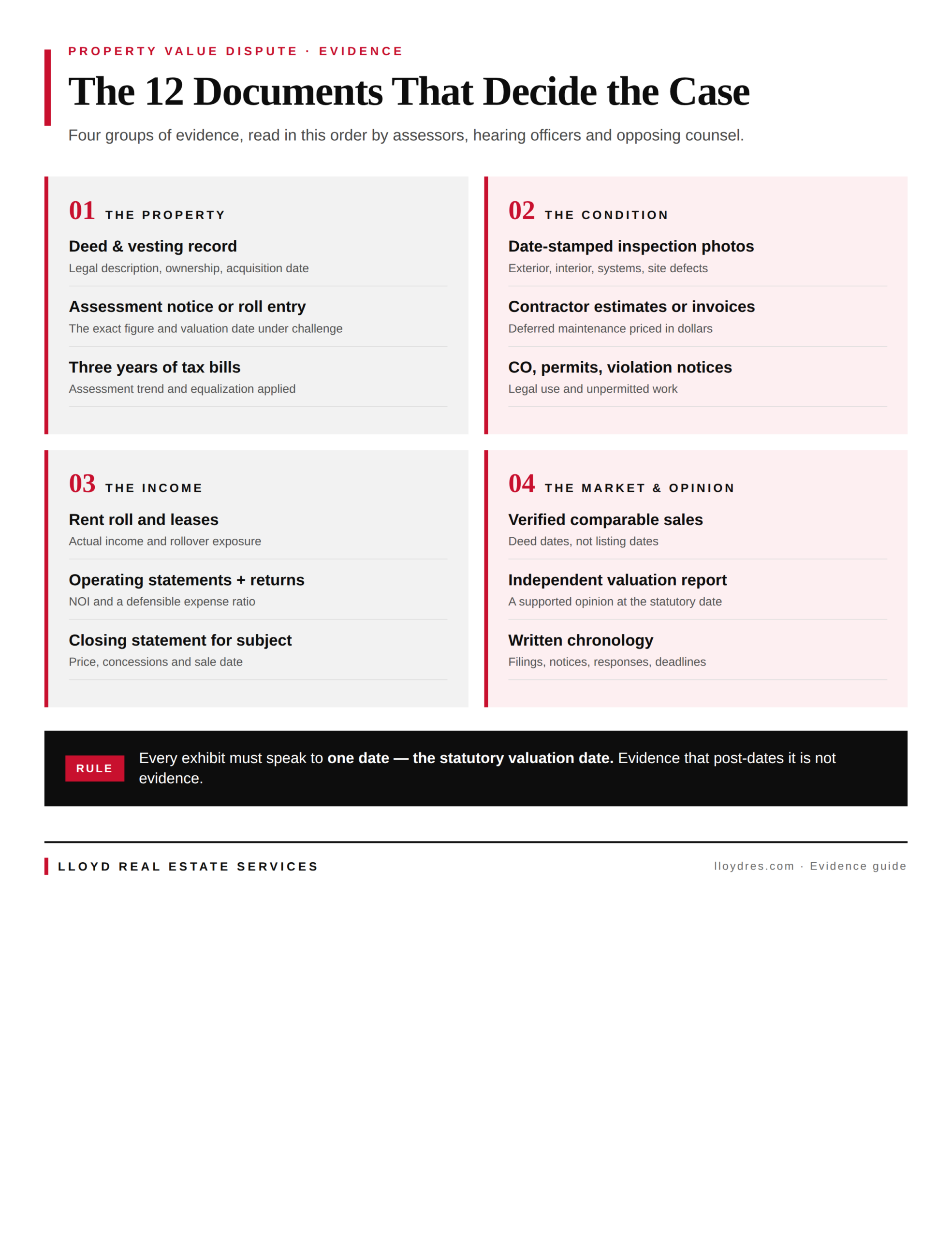
The 12 documents that decide the case
These are the records that consistently carry weight in residential, multi-family and commercial disputes. Missing one is not fatal; missing a category usually is.
| Document | What it proves | Typical source |
|---|---|---|
| 1. Deed and vesting record | Legal description, ownership and acquisition date | County clerk or register |
| 2. Assessment notice or roll entry | The exact figure, tax class and valuation date under challenge | Assessor or Department of Finance |
| 3. Three years of tax bills | How the assessment has moved, and any equalization applied | Treasurer or collector |
| 4. Date-stamped inspection photos | Actual condition and quality versus the assessor’s description | Your own inspection, exterior and interior |
| 5. Contractor estimates or invoices | Deferred maintenance and its cost in dollars | Two or three licensed contractors |
| 6. Certificate of occupancy, permits, violations | Legal use, unpermitted work, municipal orders | Buildings department, permit portal |
| 7. Rent roll and leases | Actual income, lease terms and rollover exposure | Owner or property manager |
| 8. Operating statements reconciled to returns | Net operating income and a defensible expense ratio | Two to three years of filings |
| 9. Closing statement for the subject | Price, concessions and date of the last arm’s-length sale | Title company or closing attorney |
| 10. Verified comparable sales | The market’s own evidence, by deed date rather than listing date | Deed research, MLS, registry |
| 11. Independent valuation report | A supported opinion as of the statutory date | A qualified appraiser or expert |
| 12. Written chronology of the dispute | Procedural compliance: filings, notices, responses, deadlines | Your own correspondence file |
The pattern matters more than the list: items 1 through 6 establish what the property is, 7 through 9 establish what it earns, 10 establishes what the market paid, and 11 through 12 convert all of it into an argument a board can adopt.
Three gaps that sink otherwise strong claims
Wrong date. Owners routinely argue from today’s market, or from the month values peaked. If the valuation date is January 1 of the prior year, sales from eighteen months later are irrelevant, and a board will say so in one sentence.
Asserted condition, no proof. “The roof is failing” is an opinion. A roofing contractor’s itemized bid dated before the valuation date is evidence. Photographs without dates are close to worthless, which is why inspection files should be captured in a single dated pass.
Comparables that are not comparable. A sale with different use, gross building area, condition or seller financing gives the assessor an easy target. Screen aggressively: same use, same market segment, similar size, arm’s-length terms, within a defensible time window of the valuation date.
How Lloyd Real Estate Services assembles the file
The firm’s review follows five fixed steps, in this order:
- Lock the valuation date and list every deadline attached to it, including filing and inspection access.
- Inspect and document the property in one dated pass — exterior, interior, systems, site, and any adverse conditions.
- Reconcile the income to filed returns, the rent roll and the leases, normalizing one-time items rather than copying last year’s schedule.
- Build the comparable set from verified deed and closing data, then test it against the subject’s size, condition and date of sale.
- Index the exhibits and write the report so that every conclusion cites a specific page in the file.
Tips that change the outcome
- Start ninety days before the deadline. Inspection, contractor bids and income reconciliation take weeks, not days.
- Photograph the boring things. Water stains, dated mechanicals, cracked paving and an outdated kitchen carry more weight than the facade.
- Keep the assessor’s own record. If the assessor’s description lists a renovation, a bedroom count or a square footage you dispute, that discrepancy is often the fastest path to a reduction.
- Do not substitute an online estimate for an appraisal. Automated values are a lead, never an exhibit that a hearing officer can test.
Which forum applies? Compare a property value dispute versus a tax grievance versus an appraisal challenge.
Frequently asked questions
What evidence is most persuasive in a property value dispute?
Verified arm’s-length sales near the valuation date, paired with a dated inspection record showing the property’s condition on that date. Together they answer both questions a board asks: what was it worth, and what was it actually like.
Do I need an appraisal to file an appeal?
Usually not to file — most jurisdictions accept a petition with the essential facts. At hearing, an independent valuation report is what converts a claim into a supported case.
Can I use Zillow or another automated estimate as evidence?
No. Automated valuations are not auditable, are not property-specific, and cannot be cross-examined. Use them only to decide whether a review is worth commissioning.
How far back should my records go?
Three years of income and expenses, and sales within twelve to twenty-four months of the valuation date, with the strongest weight on the six months closest to it.
Ready to test the number? Lloyd Real Estate Services prepares the evidence file and the written opinion together, so the report and the exhibits never disagree. Request a property value dispute review and bring the assessment notice — the file can usually be scoped in one call.