

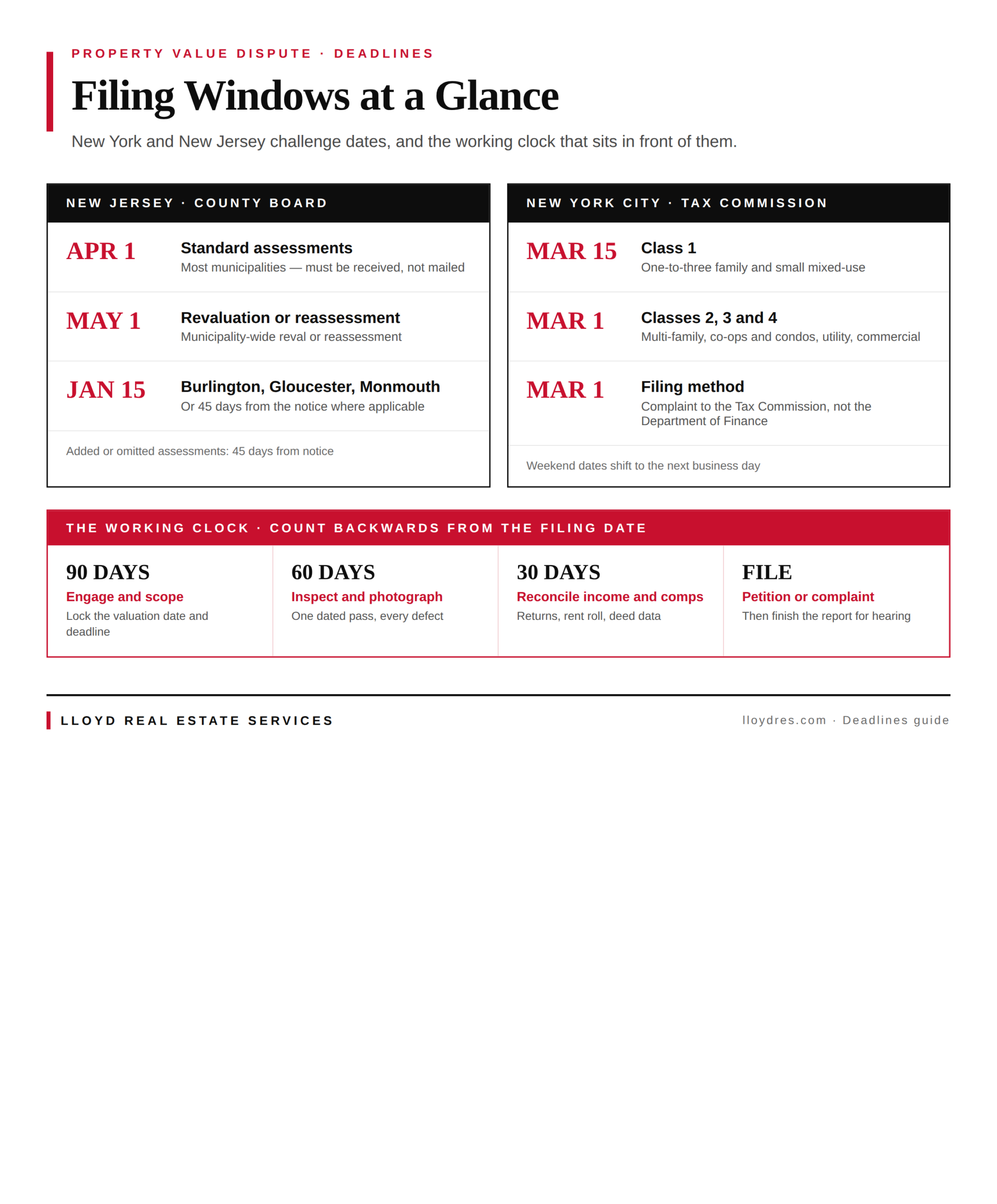
Missing a filing window is the most expensive mistake in a property value dispute. The claim does not get weaker — it disappears. In New Jersey, most petitions must be received by April 1, with May 1 in revaluation and reassessment municipalities and January 15 in Burlington, Gloucester and Monmouth counties. In New York City, Tax Commission challenges close March 15 for Class 1 properties and March 1 for Classes 2, 3 and 4.
Lloyd Real Estate Services builds every dispute backwards from those dates, because a valuation report completed after the window closes has no forum to be heard in.
Key Takeaways
- Two dates get confused: the valuation or assessment date the figure describes, and the filing deadline that lets you challenge it. They are not the same day.
- New Jersey’s general deadline is April 1; revaluation and reassessment towns move to May 1; Burlington, Gloucester and Monmouth run on a January 15 cycle.
- New York City closes March 15 for Class 1 and March 1 for Classes 2, 3 and 4 — and shifts to the next business day when those dates fall on a weekend.
- A report needs two to four weeks after inspection, so evidence work must begin roughly 90 days before the filing date.
- A missed deadline is rarely recoverable, but it is not the end of the calendar — the next roll, a correction claim, or an omitted assessment may still be open.
In This Guide
- The two dates every owner confuses
- New Jersey filing windows
- New York City filing windows
- What happens if you miss the window
- Why the calendar decides whether a case is possible
- Tips for building a 120-day dispute calendar
- Frequently asked questions
The two dates every owner confuses
The valuation date is the moment the assessment describes — in New Jersey, the October 1 preceding the tax year, and in New York City, the date the tentative roll values the property for the coming fiscal year. The filing deadline is the last day a petition or complaint can be received. Evidence must be dated to the first; the paperwork must arrive by the second.
New Jersey filing windows
| Property situation | Filing deadline | Forum |
|---|---|---|
| Standard assessment, most municipalities | April 1 | County Board of Taxation |
| Municipality-wide revaluation or reassessment | May 1 | County Board of Taxation |
| Burlington, Gloucester and Monmouth counties | January 15, or 45 days from the notice where applicable | County Board of Taxation |
| Added or omitted assessment | Within 45 days of the notice | County Board of Taxation |
The April 1 rule is statutory and strictly applied: a petition that arrives on April 2 is untimely regardless of merit. The New Jersey Division of Taxation publishes the current schedule, and the county board’s own notice controls if a date is adjusted.
New York City filing windows
| Tax class | Typical property | Filing deadline |
|---|---|---|
| Class 1 | One-to-three family homes and small mixed-use | March 15 |
| Class 2 | Multi-family rental and cooperatives/condominiums | March 1 |
| Class 3 | Utility property | March 1 |
| Class 4 | Commercial and industrial | March 1 |
New York City complaints go to the Tax Commission, not to the Department of Finance. When March 1 or March 15 falls on a weekend, the operative date moves to the next business day — which is why the city publishes a revised date each cycle. Owners outside the five boroughs file with their local assessor or board of assessment review on that municipality’s own grievance day, usually in spring; there is no single statewide date.
What happens if you miss the window
The assessment stands for that tax year, and the tax is payable as billed. Merit does not reopen a closed filing period. In practice, an owner who misses a deadline has four realistic routes:
- The next roll. A new assessment year brings a new window — useful only if the over-assessment persists.
- A correction claim. Some jurisdictions allow clerical-error or error-in-valuation relief outside the ordinary appeal, with a higher evidentiary burden.
- An appeal of a board judgment. Where a county board has ruled, a further appeal to the Tax Court runs on a short statutory clock from the judgment, not from the original notice.
- A different forum. Where the dispute is really about a lender appraisal, a purchase price or a buy-out, the valuation question belongs in the transaction or litigation file, not the tax calendar.
Why the calendar decides whether a case is possible
A defensible report is not a document that can be produced in a week. Inspection access, contractor bids, income reconciliation and comparable-sale verification typically consume two to four weeks after engagement, and hearing preparation consumes more. Working backwards from a March 1 filing, the evidence phase realistically begins in November or December.
Lloyd Real Estate Services experts recommend a simple test at intake: count backwards 90 days from the filing date. If the inspection cannot be scheduled inside that window, the case either needs a compressed scope or a decision to target the following roll — and that decision should be made on the record, not discovered at the counter.
Tips for building a 120-day dispute calendar
- Diarise three dates, not one: the valuation date, the filing deadline, and the last day an inspection can realistically happen.
- File before you are ready to argue. Most petitions need facts, not a finished report; the report follows during the hearing phase.
- Confirm the date with the county or city, in writing. Published tables go stale, and a revaluation changes the deadline for a whole municipality.
- Keep proof of delivery. Timeliness is measured by receipt, not by postmark, in most New Jersey filings.
Frequently asked questions
What is the deadline to appeal a property assessment in New Jersey?
April 1 for most municipalities, May 1 where a revaluation or reassessment is in effect, January 15 in Burlington, Gloucester and Monmouth counties, and 45 days from the notice for added or omitted assessments. The petition must be received — not mailed — by the date.
When is the New York City property tax challenge deadline?
March 15 for Class 1 properties and March 1 for Classes 2, 3 and 4, filed with the New York City Tax Commission. When those dates fall on a weekend, the deadline moves to the next business day.
Can I file a property value dispute after the deadline?
Not for the same tax year, in the ordinary case. A late filing is dismissed as untimely; the remaining options are the next roll, a correction claim where allowed, or an appeal of an existing judgment.
How early should I hire an expert before the filing deadline?
Ninety days is the working minimum for a residential file, and longer for income-producing property where leases, rent rolls and operating statements must be reconciled. Engaging after the report is due is the single most common reason a valid claim is filed unsupported.
Check your window before anything else. Lloyd Real Estate Services reviews the assessment notice against the applicable calendar first, then scopes the evidence work to fit it. Start a property value dispute review with the notice and the property address.