

An inherited property carries two values at once: what the estate says it was worth on the date of death, and what the assessor says it is worth on the assessment date. When those numbers diverge, the dispute is rarely about the house. It is about which date controls, what condition the property was in, and whether the executor can prove both.
Lloyd Real Estate Services handles estate and trust valuation disputes on exactly that basis — a retrospective opinion as of the date of death, tested against the assessment the heirs are now paying.
Key Takeaways
- Date-of-death value and assessed value answer different legal questions; one does not automatically correct the other.
- A retroactive appraisal is the only way to prove condition and market at a past date, and it requires a documented condition timeline.
- Estate sales, related-party transfers and as-is dispositions are usually discounted as evidence of market value.
- Executors carry a fiduciary duty to substantiate value — for estate tax purposes and for any property tax challenge.
- Vacancy, deferred maintenance and post-death damage all reduce value, but only if they are dated and photographed.
In This Guide
- Why inherited property disputes are different
- Four problems that drive estate valuation disputes
- The solutions that hold up
- What executors and trustees owe the estate
- Tips for heirs, executors and attorneys
- Frequently asked questions
Why inherited property disputes are different
A standard assessment challenge asks one question: is the assessor’s figure supported as of the valuation date? An inherited property adds two more dates — the date of death, which fixes basis and estate value, and the date of any sale, which fixes what the market eventually paid.
Nothing forces those three numbers to agree. An estate may report a date-of-death value that reflects a house full of furniture and a working heating system, while the assessor values a vacant property two years later on a market that has moved. Heirs typically discover the mismatch when the first tax bill arrives in the estate’s name, months after the filing window for the death year has closed.
Four problems that drive estate valuation disputes
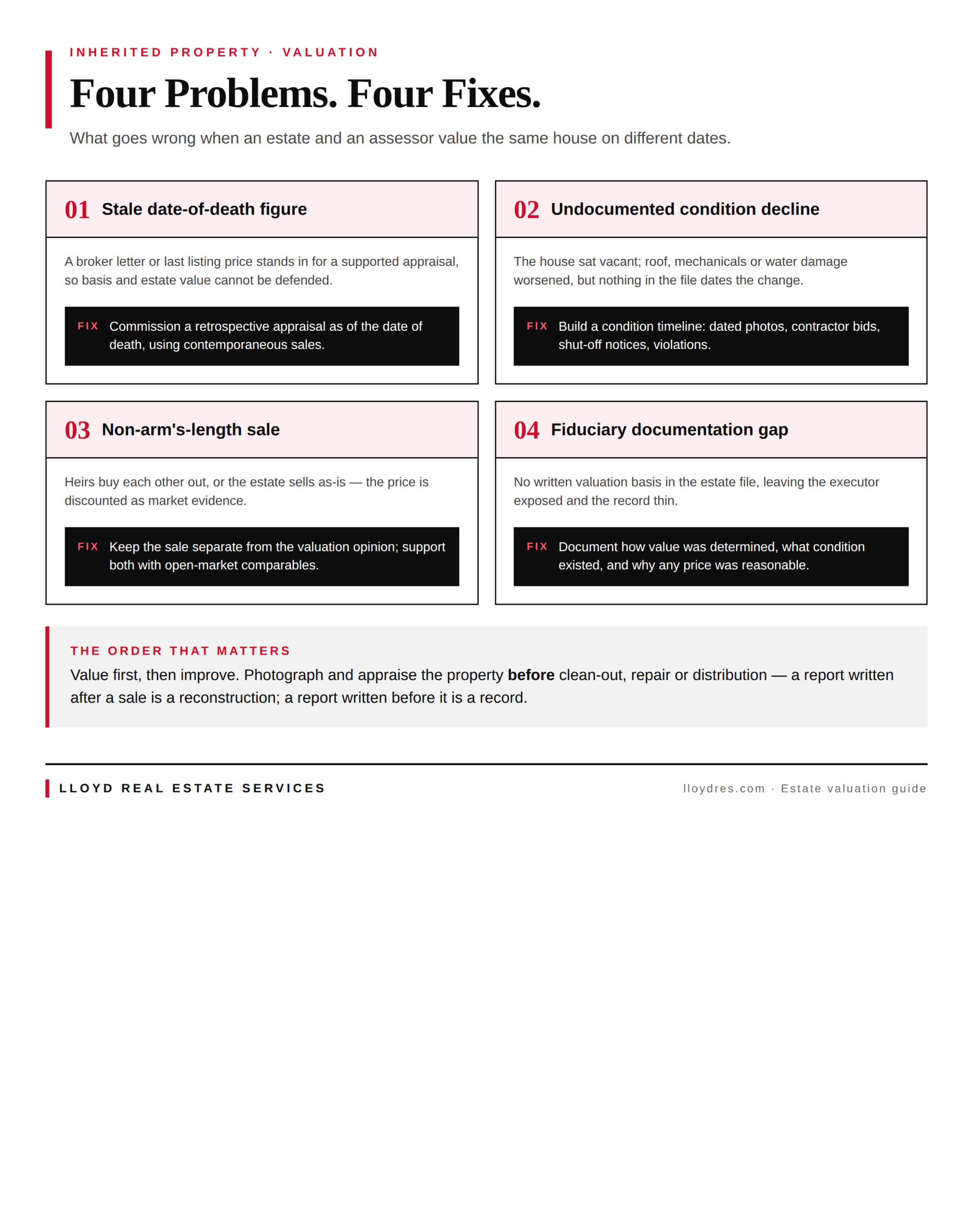
| Problem | What goes wrong | Why it costs money |
|---|---|---|
| 1. Stale date-of-death figure | The estate relies on a broker’s letter opinion or an old listing price rather than a supported appraisal | Basis and estate value are challenged, and the figure cannot be defended retroactively |
| 2. Undocumented condition decline | Property sat vacant for a year; roof, mechanicals or water damage worsened | No dated evidence means the decline is treated as an excuse, not a fact |
| 3. Non-arm’s-length sale | Heirs buy each other out, or the estate sells as-is to a contractor | The price is discounted as evidence of market value, so it cannot anchor the assessment challenge |
| 4. Fiduciary documentation gap | No written valuation basis in the estate file | Exposure for the executor, and a weak record for any later dispute |
Each of these is a records problem before it is a valuation problem, which is why they are fixable — provided someone starts before the property is sold or substantially altered.
The solutions that hold up
Commission a retrospective appraisal. A qualified appraiser can value property as of a past date using contemporaneous sales, listing histories and a documented condition record. This is the only opinion that speaks to the date of death, and it is materially different from a current valuation.
Build a condition timeline. Photographs taken at the death, at each inspection, and at any repair; contractor bids dated to the period; utility shut-off notices; municipal violation records. Together they establish what the property was, not what it became.
Separate the two proceedings. The estate tax valuation and the property tax challenge run on different calendars, different standards and different evidence rules. A report prepared for one is not automatically sufficient for the other, and treating them as interchangeable is how heirs lose both.
Document the decision, not just the number. Where beneficiaries disagree about listing price or a buy-out, a written valuation with an exhibits index converts a family argument into a defensible position — which is often the real value of the exercise.
What executors and trustees owe the estate
Fiduciary duty requires reasonable inquiry, not perfect foresight. In practice that means the executor should be able to show: how value was determined, what the property’s condition was at the relevant date, what was done to preserve it, and why any sale price was reasonable.
Lloyd Real Estate Services experts recommend that the valuation report be commissioned while the property is still in estate hands and before any distribution, because access, condition and comparables are all easier to establish then. A report written after a sale is a reconstruction; a report written before it is a record.
Tips for heirs, executors and attorneys
- Photograph the property within days of death — every room, every system, every defect, with dates.
- Keep the estate’s own correspondence with the assessor; it is exhibit material in any later challenge.
- Do not improve before you document. Cleaning out and repairing raises value and destroys the evidence that supported the lower figure.
- Watch the calendar. The assessment challenge window for the year of death may close before the estate is even opened; the following roll is often the realistic target.
- Ask for the report in writing, with exhibits indexed by page so the conclusion and the evidence can be checked against each other.
For estates that also face a lender appraisal or a buy-out negotiation, the same file supports all three conversations — see why an expert valuation differs from a tax assessment, lender appraisal or online estimate.
Frequently asked questions
Can I dispute a property tax assessment on a house I inherited?
Yes. Ownership through an estate does not change the appeal rights; the executor or trustee files on behalf of the estate, and the evidence must address the same valuation date and condition standards as any other challenge.
What value should the estate use — the date of death or the current assessment?
Both, for different purposes. The date-of-death value establishes basis and estate value; the assessed value determines the property tax. A retrospective appraisal is what reconciles the two when they diverge.
Is a probate or estate sale price good evidence of market value?
Usually not on its own. Estate sales, related-party transfers and as-is disposals are treated as potentially non-arm’s-length, so they carry less weight than open-market sales of comparable property near the relevant date.
How long does an estate valuation take?
Typically three to six weeks for a retrospective report, longer where records are scattered or the property has been altered. Starting before distribution shortens it considerably.
Inherited property, unresolved number? Lloyd Real Estate Services prepares retrospective valuations and the assessment challenge file together, so the estate has one consistent position. Request an estate valuation review.