

The appraisal came in low, the deal is suddenly underwater, and the closing clock is ticking. Take a breath: a low appraisal is a problem with a playbook. Here are the proven steps — the ones experts recommend — to dispute it, protect your price, and keep your sale or refinance alive.
Key Takeaways
- Yes, you can dispute a low appraisal — the formal route is a Reconsideration of Value (ROV) request submitted through the lender with new evidence.
- Most low appraisals trace back to four causes: weak or stale comparables, missed upgrades, unseen condition issues, and rushed or out-of-area appraisers.
- Never argue value with opinions — win with documented facts: better comps, an upgrade list with costs and permits, and corrected data.
- Response windows are short (often just days), so start the dispute immediately after receiving the appraisal report.
- The Property Value Dispute Expert Service at Lloyd Real Estate Services supplies the independent valuation and comp analysis experts recommend for a successful challenge.
Table of Contents
Can You Dispute a Low Appraisal?
Yes — a low appraisal can be disputed through a Reconsideration of Value, in which the lender asks the appraiser to review new evidence and correct the report. You cannot simply demand a higher number; you must submit factual material the appraiser did not have — stronger comparable sales, corrected property data, or documentation of upgrades and condition. Appraisers and lenders accept revised values regularly when the new evidence is specific, recent, and verifiable.
Why Appraisals Come in Low
Most low appraisals are evidence problems, not wrong opinions. Understanding the cause tells you which fix to pursue:
| Cause | What Happened | The Fix |
|---|---|---|
| Weak comparables | Appraiser used older or dissimilar sales | Supply 3–6 recent, similar closed sales |
| Missed upgrades | Renovations not visible or not documented | Upgrade list with dates, costs, permits |
| Data errors | Wrong square footage, bed/bath count, lot data | Corrected measurements and records |
| Condition issues | Roof, systems, or deferred maintenance noted | Repair estimates or completed-repair proof |
| Rushed market timing | Prices rose faster than recent sales reflect | Pending sales and current market data |
How to Dispute a Low Appraisal: 6 Proven Steps
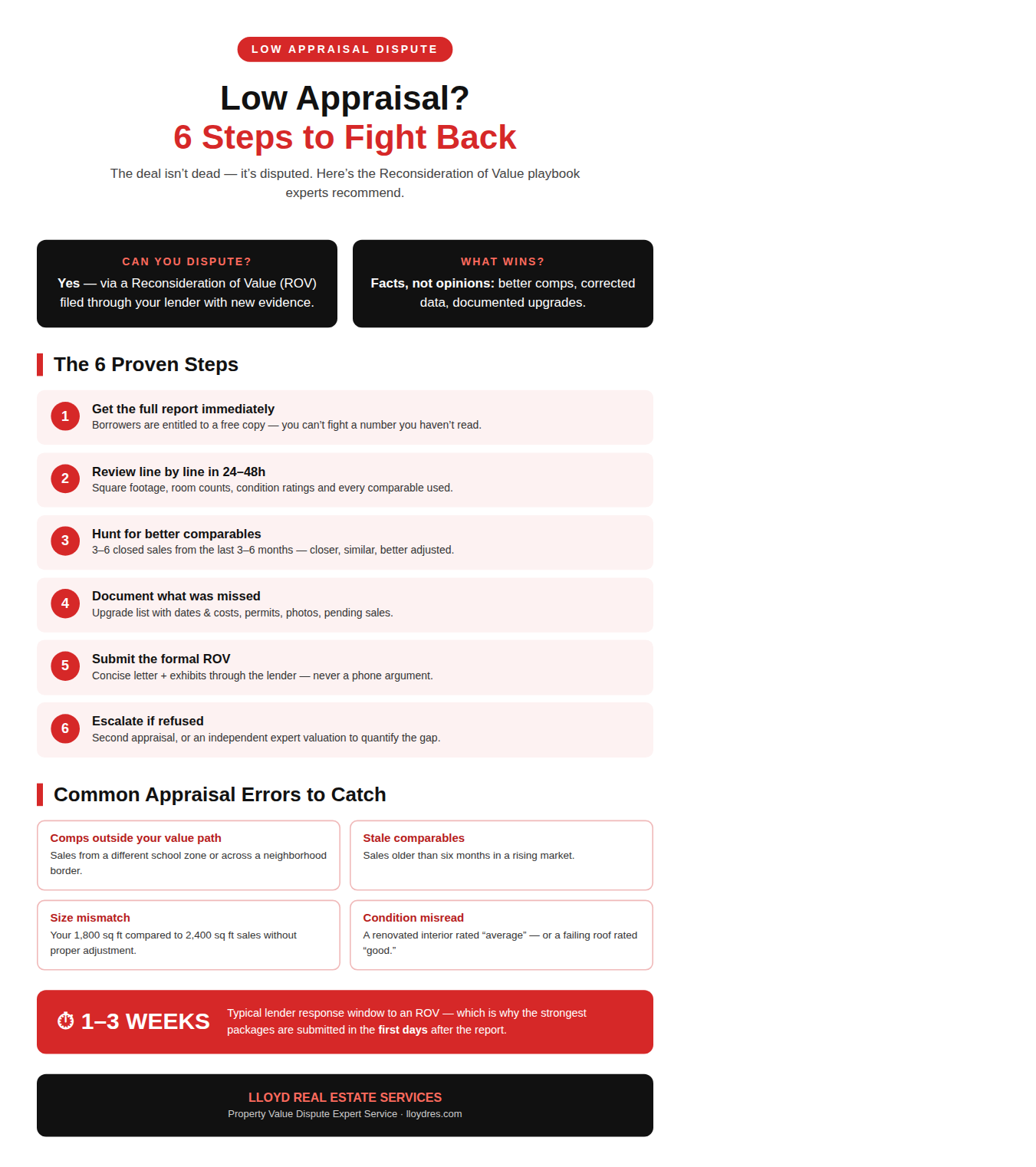
A successful appraisal dispute is a sprint — most lenders expect an ROV request within days of the report, not weeks. Here is the sequence experts recommend:
- Get the full appraisal report immediately. Borrowers are entitled to a copy free of charge. You cannot fight a number you have not read.
- Review it line by line within 24–48 hours. Check square footage, room counts, condition ratings, and every comparable used — distance, sale date, size, and adjustments.
- Hunt for better comparables. Find closed sales from the last 3–6 months that are closer, more similar, or better adjusted than the appraiser’s picks. This is the heart of nearly every winning dispute.
- Document everything the appraiser missed: a written upgrade list with dates and costs, permits, before/after photos, and any pending sales showing current demand.
- Submit a formal Reconsideration of Value through the lender. Deliver a concise letter plus exhibits — never a phone argument. Ask specifically which comps the appraiser will reconsider.
- Escalate with a second appraisal or expert review. If the lender refuses, request a different appraiser, or bring in an independent expert to quantify the gap and negotiate with data.
Common Appraisal Errors (and How to Catch Them)
- Comps outside the value path: sales from a different school zone or across a highway that borders your neighborhood.
- Stale comps: sales older than six months in a moving market.
- Size mismatch: comparing your 1,800-sq-ft home to 2,400-sq-ft sales without proper downward adjustment.
- Condition misread: a rating of “average” for a recently renovated interior — or “good” for one with a failing roof.
- Gross living area errors: public-record square footage that never accounted for a legal addition or finished basement rules.
If the Dispute Fails: Your Backup Options
- Renegotiate the contract to a price the appraisal supports, splitting the difference where possible.
- Buyer pays the gap in cash, if the lender’s loan-to-value still works and the buyer wants the home enough.
- Order a second appraisal from a different professional — some lenders allow it with justification.
- Challenge the original valuation independently. If the low number is now damaging other plans (insurance, divorce, estate), an independent valuation from a dispute expert establishes the defensible figure.
Why Experts Recommend a Property Value Dispute Expert Service
An appraisal dispute is won on comparable-sales quality and valuation credibility — exactly what a Property Value Dispute Expert Service provides. The Property Value Dispute Expert Service at Lloyd Real Estate Services reviews the full appraisal report, builds the rebuttal comp package, drafts the ROV submission, and supplies independent valuations that experts recommend when a lender won’t budge. For New York buyers and sellers, that means a faster response, a stronger file, and a far better chance of closing at your real price instead of the appraiser’s.
Frequently Asked Questions
Can a seller dispute a low appraisal?
Yes. Formally, the dispute runs through the lender and borrower, but sellers can supply comps, upgrade documentation, and market data through the listing agent — and most winning ROV packages include seller-provided evidence.
How long does an appraisal dispute take?
Lenders typically respond to a Reconsideration of Value within one to three weeks. That is why speed matters: a well-built ROV submitted in the first days after the report keeps your closing date intact.
What is the success rate of appraisal disputes?
ROVs with genuinely stronger comparables and corrected data succeed frequently; packages that merely disagree with the value rarely change anything. Evidence quality — not persistence — drives the outcome.
Does a disputed appraisal count against the appraiser?
No. Reconsideration of Value is a normal, accepted part of the process. Appraisers expect and accommodate legitimate new evidence; the process exists precisely so errors can be corrected.
Deal on the line? Contact the Property Value Dispute Expert Service at Lloyd Real Estate Services today for an urgent appraisal review and rebuttal package before your ROV window closes.