

A condo or co-op property value dispute in New York City rarely starts with your apartment. It starts with a number the Department of Finance assigned to an entire building. Because New York values Class 2 housing as if the building were a rental, your assessed value can drift far from what a buyer would pay. This guide covers the problems behind that gap, the solutions that move a number, and the tips the Property Value Dispute Expert Service at Lloyd Real Estate Services gives owners before they file.
Key Takeaways
- New York assesses co-ops and condos as if the building were a rental, so your unit’s market value and its assessed value are two different measurements.
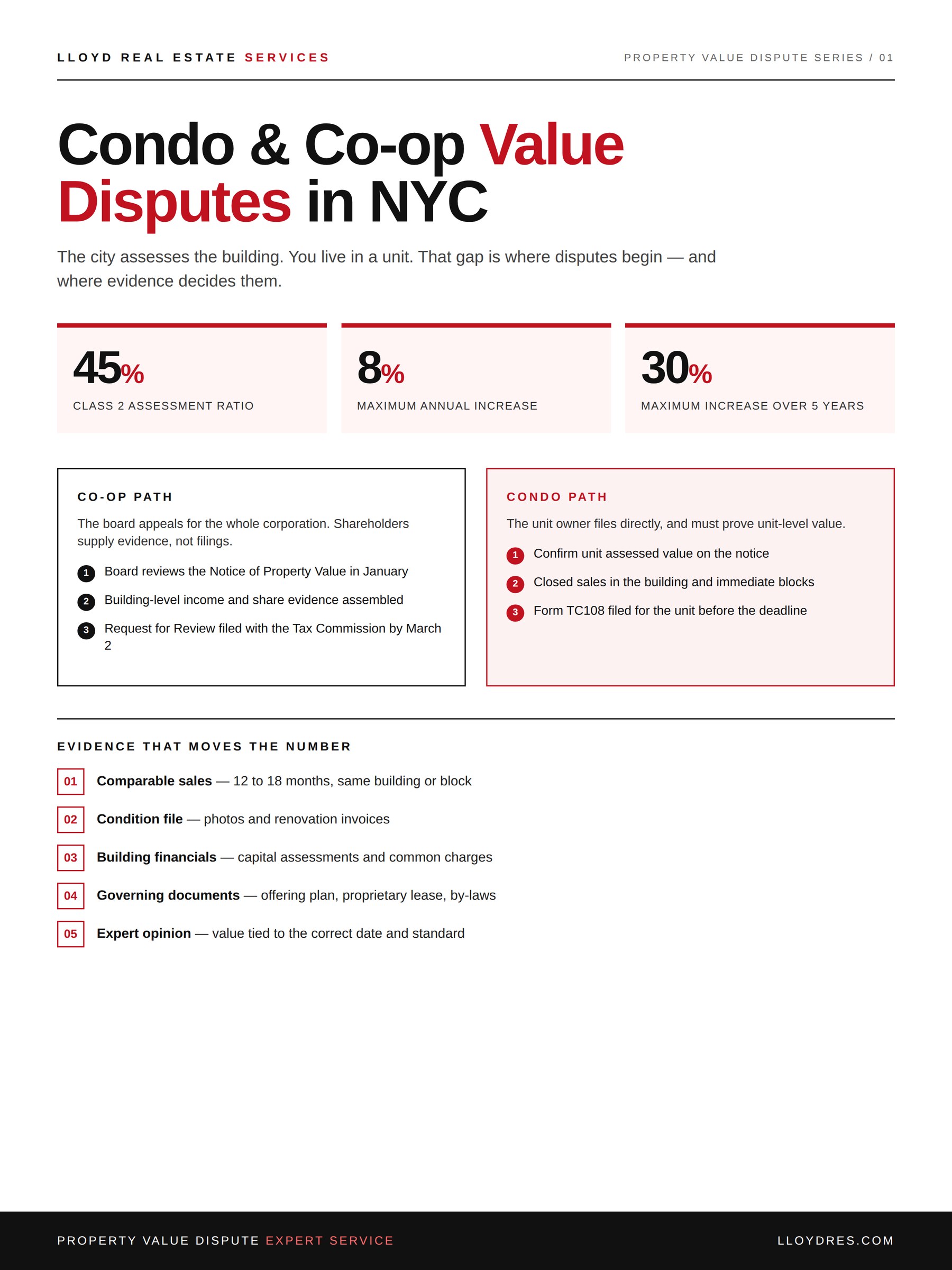
- Class 2 assessments use a 45% assessment ratio, with increases capped at 8% a year and 30% over five years.
- Co-op shareholders generally cannot appeal alone — the board challenges the building. Condo owners can file for their own unit.
- For the 2026–27 tax year, Class 2 Requests for Review were due March 2, 2026. Missing the window costs a full year.
Why Condo and Co-op Disputes Are Different in New York
Most of the country taxes homes on a sales-comparison basis. New York City does not. State law requires co-ops and condos in Class 2 to be valued as if the building were income-producing rental property, then applies a 45% assessment ratio to that value. Increases are also capped at 8% per year and 30% over five years, which means a hot submarket can leave an assessment lagging reality — and a soft one can leave it stubbornly high.
The practical result: your Notice of Property Value describes a hypothetical building, not the two-bedroom with the renovated kitchen that a buyer toured last weekend. Two units in the same building can carry very different tax burdens because the cap and the assessment roll history differ, not because one apartment is worth dramatically more.
Four Problems That Trigger a Unit-Level Value Dispute
1. The assessment is building-level, but the complaint is unit-level
A co-op’s assessment covers the whole corporation, so a shareholder with a grievance has no individual appeal — the board must act for everyone. Condo owners have more direct standing but still inherit a building-level valuation that ignores unit-level differences in line, floor, and condition.
2. The comparables are the wrong comparables
Assessment challenges fail when owners submit sponsor sales, new-development contracts, or condo sales used against a co-op. A co-op sale reflects shares and a proprietary lease, not a deed.
3. Renovations and common charges are ignored
A gut renovation can raise market value while the assessed value barely moves; a building-wide facade project can add debt and common charges that depress unit value while the assessment stays put. Both directions create a legitimate dispute, and both require documentation the owner usually has never assembled.
4. The abatement is confused with the assessment
The co-op and condo abatement reduces a tax bill; it does not change assessed value. Owners who point to a credit as proof of over-assessment are arguing about the wrong line of the bill.
The Solutions: Two Appeal Paths, One Deadline
New York gives owners a specific administrative remedy: a Request for Review filed with the NYC Tax Commission.
Co-op shareholders: the board of directors files on behalf of the building. Shareholders influence the outcome by giving the board evidence — comparable sales, capital needs, maintenance trends — but they rarely file individually.
Condo owners: the unit owner can file a Request for Review for their own unit, using Form TC108, and can support it with unit-level comparables and condition evidence.
The window is short. Notices of Property Value arrive in mid-January, and for the 2026–27 tax year Class 2 Requests for Review were due March 2, 2026. If you are reading this after that date, the productive move is to document the case now and file in the next cycle — not to file late and lose the argument on procedure.
Where the facts support it, the Property Value Dispute Expert Service prepares the valuation support, reconciles the comparables, and produces a written opinion the board, the Tax Commission, or counsel can rely on.
Evidence That Actually Changes the Number
| Document | What it proves |
|---|---|
| Closed comparable sales (12–18 months, same building or immediate blocks) | Whether the assessment tracks real transactions rather than a hypothetical rent roll |
| Unit condition photos and renovation invoices | Whether the model captures improvements — or penalizes a unit that lacks them |
| Building financials and capital assessments | Whether common charges and deferred work depress unit value |
| Independent appraisal or expert report | A defensible opinion of value tied to the correct date and standard |
Zillow estimates, neighbor opinions, and last year’s tax bill do not survive a review. For the fuller list, see our guide to the 12 documents that decide an over-assessment case.
Expert Tips Before You File
Tip 1 — Read the notice before you argue. Confirm the tax class, assessed value, market value, and exemptions.
Tip 2 — Match the evidence to the standard. A co-op needs building-level income and share evidence; a condo needs unit-level sales. Submitting the wrong category signals inexperience.
Tip 3 — Date your evidence correctly. Value is measured on the taxable status date, not today; a later closing may be irrelevant.
Tip 4 — Coordinate with the board. In a co-op, a shareholder campaign without board support usually dies.
Tip 5 — Get a second opinion before the deadline, not after. The Property Value Dispute Expert Service reviews cases year-round precisely because the filing window is unforgiving.
Frequently Asked Questions
Can a co-op shareholder appeal the building’s assessment alone?
Generally no. The building is assessed as a single property, so the board files for the corporation. Shareholders can and should supply evidence, but the appeal belongs to the co-op.
Is a condo owner’s appeal different from a co-op board’s?
Yes. A condo owner can file for their own unit; a co-op appeal covers the whole building, and every shareholder benefits.
Does a high sale price in my building automatically raise my assessment?
Not immediately. Class 2 increases are capped at 8% a year and 30% over five years, which is why assessments can lag a fast market — and why a soft market can leave you over-assessed.
How much does an expert cost compared with the tax savings?
It depends on the building and the evidence. Have the case reviewed first — if the gap is small, a report will not pay for itself, and a good expert will say so.
Get Your Condo or Co-op Number Reviewed
Lloyd Real Estate Services provides independent valuation support for owners, boards, and attorneys across New York City. If your assessed and market values have drifted apart, the Property Value Dispute Expert Service can tell you whether you have a case worth filing.
Request a property value dispute review from Lloyd Real Estate Services →