
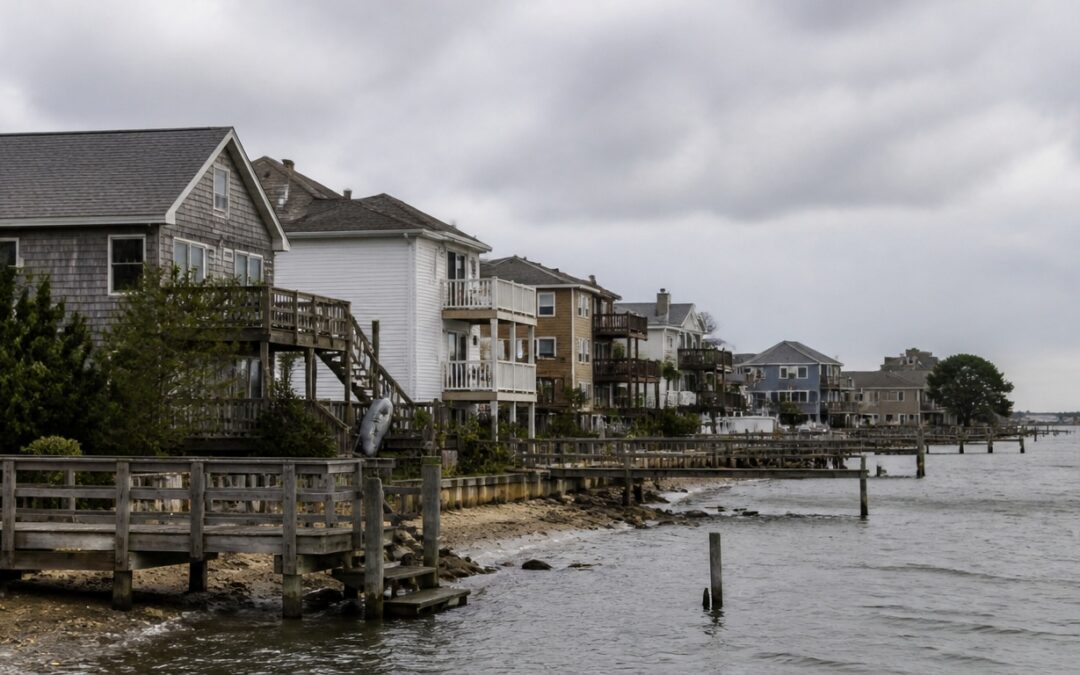
Flood risk becomes a property value dispute when two parties price the same house with two different assumptions about water. A lender, an insurer, an assessor, and a buyer can each attach a different cost to a flood zone designation — and that gap is now a leading source of valuation conflict in New York. Here is where these disputes come from, how to prove a risk adjustment, and how the Property Value Dispute Expert Service at Lloyd Real Estate Services approaches them.
Key Takeaways
- A flood zone designation affects value through insurance cost, lender requirements, buyer perception, and rebuild cost — not through the map line alone.
- Risk-adjusted comparables are the core of a defensible flood-related valuation opinion; sales outside the zone need explicit adjustment, not silent exclusion.
- Elevation certificates, letters of map amendment, and premium quotes convert vague fear into a number.
- Post-storm repairs and code upgrades can raise value even as the underlying risk raises cost — both must appear in the analysis.
Why Flood Risk Is a Valuation Issue, Not Just an Insurance Issue
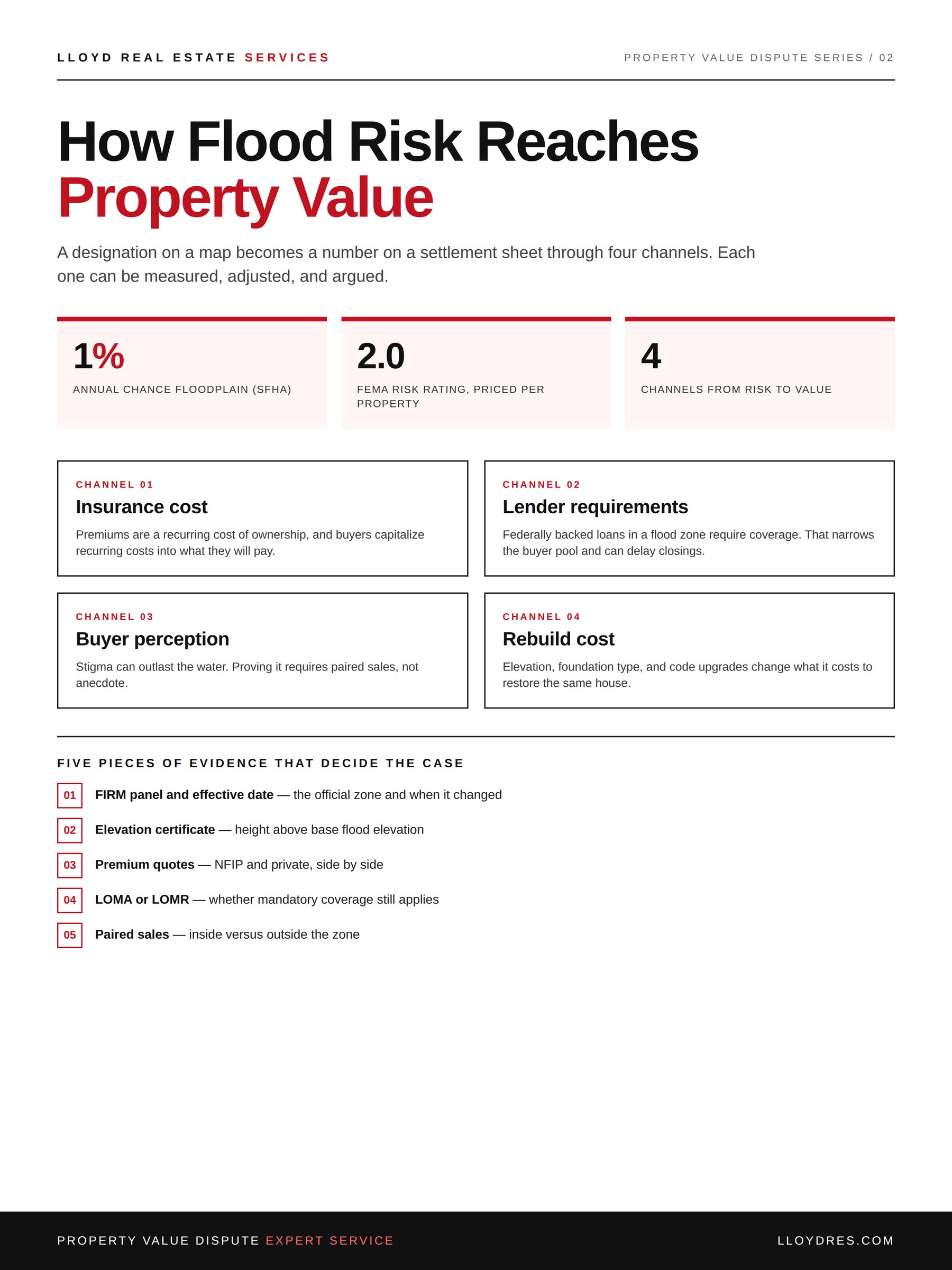
A Special Flood Hazard Area — the one-percent annual chance floodplain — triggers mandatory flood insurance for federally backed mortgages. Since FEMA’s Risk Rating 2.0 replaced zone-based pricing with property-specific pricing, two houses on the same block can carry materially different premiums based on elevation, foundation type, and replacement cost. That premium is a recurring cost of ownership, and recurring costs are capitalized into value.
That is the mechanism most owners miss. Flood risk does not reduce value because buyers are nervous. It reduces value because the annual cost of carrying the property rises, and because the pool of buyers who can absorb that cost shrinks. Appraisers, assessors, and courts all recognize that logic — but only when someone quantifies it.
Five Problems Owners Run Into
1. The map changed and nobody adjusted the number
When flood maps are revised, newly included properties can see insurance requirements and premiums jump overnight. Assessment rolls and lender appraisals frequently lag that change in both directions.
2. Comparables sit outside the zone
An appraisal that uses dry-ground sales to value a flood-exposed house without an adjustment is not automatically wrong — but it is incomplete. The adjustment, or its absence, is where the dispute lives.
3. Insurance is quoted but never capitalized
A $9,000 annual premium is not a footnote. It is a number that a buyer discounts into an offer. An expert converts it into a present-value impact rather than leaving it as an anecdote.
4. Repairs are counted twice — or not at all
A house rebuilt to current elevation standards may be worth more than its pre-storm self while still carrying residual risk. Valuations that ignore the upgrades, or ignore the risk, both miss the point.
5. Stigma outlives the water
Even after remediation, a property with a flood history can trade below unaffected peers. That discount is defensible when it rests on market evidence rather than assumption.
The Solutions: Making Risk Measurable
There are three practical routes, and they are not mutually exclusive.
Correct the record. If the property has been mapped into a floodplain in error, or has been elevated since the map was drawn, a Letter of Map Amendment or elevation certificate can change the official designation — and with it, the insurance requirement that drives the value gap.
Quantify the cost. Where the designation is correct, the productive argument is arithmetic: document the premium, the deductible, the required coverage, and the capital cost of mitigation, then capitalize that burden over a reasonable holding period.
Adjust the comparables. A valuation opinion should show dry-ground sales, explain the adjustment applied, and defend the size of that adjustment with paired sales or market evidence where available.
In disputes that reach litigation or arbitration, the Property Value Dispute Expert Service prepares a report that ties each of those steps to a specific date of value and a recognized standard.
The Evidence That Supports a Risk Adjustment
| Evidence | What it establishes |
|---|---|
| FEMA flood insurance rate map panel and effective date | The official zone and the date the designation changed |
| Elevation certificate | Actual elevation relative to base flood elevation — the strongest mitigation fact available |
| NFIP or private flood premium quotes | The annual carrying cost a buyer will price into an offer |
| Letters of Map Amendment or Revision | Whether the mandatory insurance requirement still applies |
| Paired sales inside and outside the zone | The market’s actual discount, rather than a theoretical one |
| Mitigation invoices and permits | Capital already invested, and the value it should add back |
For a wider checklist that applies to any over-assessment or valuation challenge, see the 12 documents that decide an over-assessment case.
Expert Tips for Flood-Affected Owners
Tip 1 — Separate the insurance problem from the value problem.
Tip 2 — Get the elevation certificate early. It is cheap relative to the dispute and it frequently changes the analysis.
Tip 3 — Never argue stigma without a paired sale. “Buyers don’t want it” is an opinion; two comparable sales, one wet and one dry, are evidence.
Tip 4 — Fix the date of value before you collect anything. Flood designations change; a valuation is only meaningful as of a specific date.
Tip 5 — Bring the expert in before the negotiation, not after it fails. A risk adjustment presented early often settles a file that would otherwise go to appraisal or court.
Frequently Asked Questions
Does a flood zone designation always reduce property value?
No. It reduces value only when it raises the cost of ownership or shrinks the buyer pool. An elevated, mitigated property with modest premiums may show little or no discount — which is why the analysis must be property-specific.
Can I dispute a value because my flood insurance went up?
You can, if you can show the increase is durable enough to affect what a buyer would pay. A one-year spike is weak evidence; a documented, recurring cost is strong evidence.
What is a Letter of Map Amendment?
It is a FEMA determination that a structure is not in a Special Flood Hazard Area despite appearing on the map, usually based on elevation. When granted, it can remove the mandatory insurance requirement.
Do I need a different expert for a flood case than for a tax appeal?
Not necessarily. The same valuation discipline applies; what changes is the evidence set — maps, elevation data, premiums, and paired sales rather than a standard comparable grid alone.
Find Out What the Risk Is Costing You
Lloyd Real Estate Services values flood-exposed and climate-affected property for owners, buyers, lenders, and attorneys across New York. If a designation, a premium, or a post-storm repair has put your number in dispute, the Property Value Dispute Expert Service can quantify the gap and tell you whether it is worth pursuing.
Request a flood risk valuation review from Lloyd Real Estate Services →