

When co-owners disagree about what a property is worth, the argument is rarely about the building — it is about the standard being applied. One side wants fair market value, the other fair value. One wants the date of separation, the other today. New York law answers each question, and the difference can run to six figures. This guide covers the problems, the routes, and the tips the Property Value Dispute Expert Service at Lloyd Real Estate Services gives owners and their attorneys.
Key Takeaways
- “Fair value” and “fair market value” are not interchangeable; the standard controls whether discounts apply.
- Under New York’s buyout statute, fair value is generally measured close to the date the dissolution petition was filed — not the date of the original falling-out.
- A partition action can force a sale, but the court’s valuation still decides who pays what to whom.
- Capital contributions, sweat equity, and unpaid expenses are separate claims from the value of the real estate.
Why Co-Owner Disputes Are Always Valuation Disputes
One owner wants out; another wants to stay. There is no arm’s-length sale, no listing, no bidding war — just two parties and an appraiser. Every dollar of the buyout and every share in a partition sale rests on a valuation someone must defend.
That is why these cases turn on methodology rather than sentiment. A co-owner who says “the house is worth $1.8 million because my neighbor’s sold for that” is making a claim about a comparable. A co-owner who says “your share is discounted 30% because you’re a minority holder” is making a claim about a standard. The Property Value Dispute Expert Service exists to test both claims against the standard the forum actually applies.
Four Problems That Drive the Fight
1. The wrong date of value
Value on the date of separation, the date of death, the date of filing, or the date of trial can differ enormously in a moving market. Fixing the wrong date can swing the outcome more than any appraisal argument.
2. Fair value versus fair market value
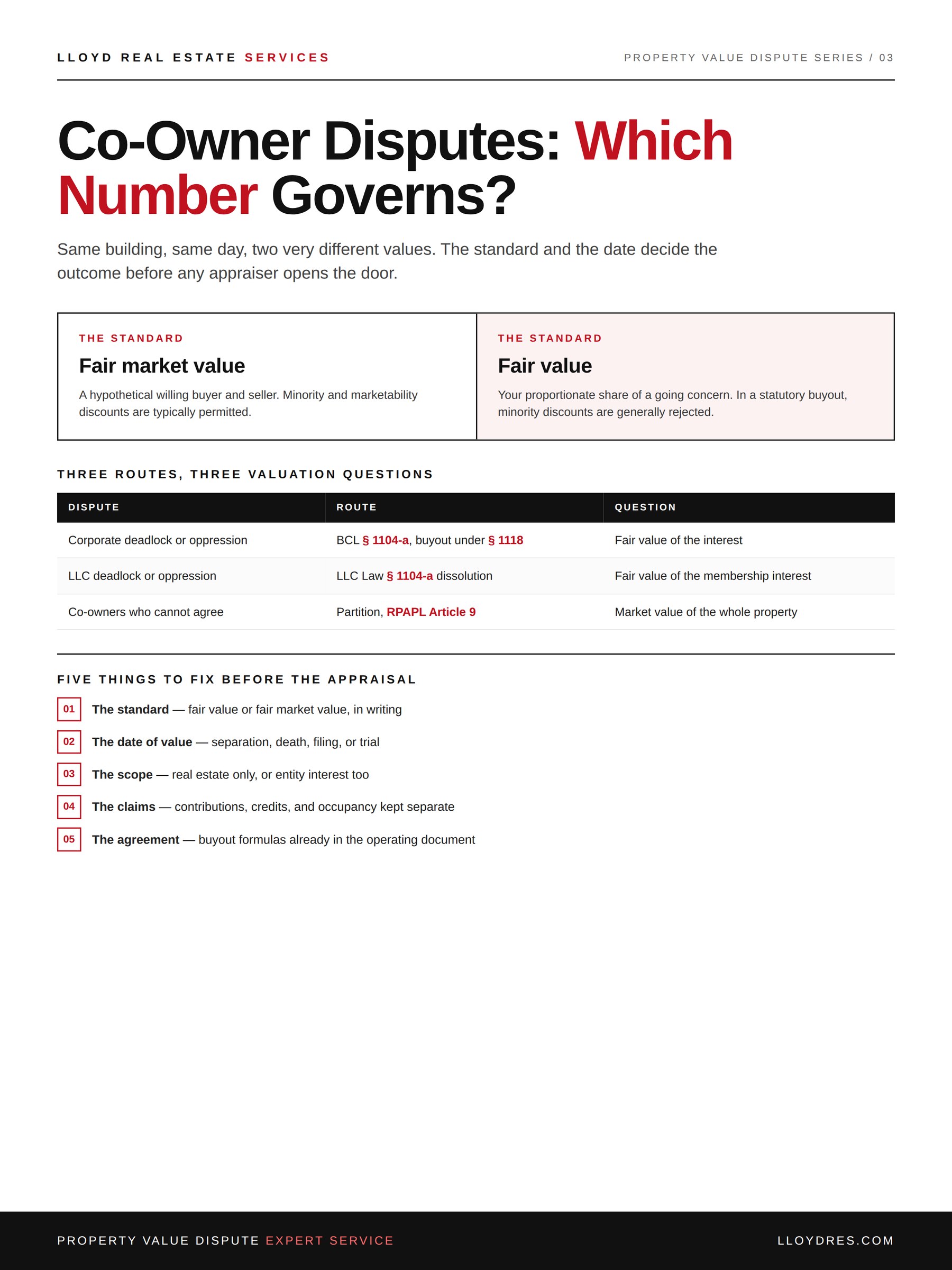
In a statutory buyout, courts typically apply fair value — the owner’s proportionate share of the enterprise as a going concern — and reject discounts for lack of marketability or minority status that a fair-market-value analysis would apply. Applying the wrong standard can move a number by a third.
3. Contributions nobody documented
One partner paid the roof; another managed the renovation; a third paid taxes for six years. Those contributions are real, but they are claims for reimbursement or credit, not automatic adjustments to the property’s value. Mixing the two muddies both.
4. Improvements that may not add value
A $200,000 renovation is not a $200,000 increase in value.
Three Legal Routes, Three Different Standards
| Dispute | Route | Valuation question |
|---|---|---|
| Deadlock or oppression in a closely held corporation | Petition for dissolution under BCL § 1104-a; buyout election under § 1118 | Fair value of the owner’s interest, typically as of the day before the petition |
| Deadlock or oppression in an LLC | Dissolution petition under LLC Law § 1104-a, with the statutory buyout election | Fair value of the membership interest, without minority discounts |
| Co-owners who simply cannot agree (joint tenancy, tenancy in common, heirs) | Partition action under RPAPL Article 9 | Market value of the whole property, then division of proceeds or an equalizing payment |
The strategic question is simple: are you buying out an interest, or selling a property? The first calls for a business-interest valuation with the real estate as the dominant asset; the second calls for an appraisal. Using one where the other belongs is the most expensive error in these cases.
The Solutions: Building a Number Both Sides Can Live With
Agree the standard first. Before anyone orders an appraisal, put in writing whether the case is a fair-value buyout or a market-value partition. Almost every expensive expert fight is a standard fight wearing a disguise.
Fix the date and the scope. Identify the valuation date and whether the interest includes cash, debt, or related entities. A valuation of the real estate alone may not answer the legal question.
Separate the property from the claims. Let the appraiser value the asset and let counsel argue credits, contributions, and offsets. Combining them produces a report that is neither credible nor admissible.
Consider a joint expert or a neutral appraisal. In many family and partnership disputes, one well-constructed independent report costs less than two adversarial ones and narrows the settlement range immediately.
Where the case is heading to mediation, arbitration, or court, the Property Value Dispute Expert Service prepares a report designed to withstand cross-examination — including the rebuttal analysis that tests the other side’s comparables and adjustments.
Expert Tips Before You Negotiate or File
Tip 1 — Read the operating agreement before the appraisal order. Buyout formulas, agreed appraisers, and valuation dates are often already written down.
Tip 2 — Do not let the adversary pick the standard by default. If you say nothing, the other side’s framing — discounts included — becomes the starting point.
Tip 3 — Document occupancy and expenses. Who lived there, who paid what, and what rent was foregone are separate recoverable claims that owners routinely forget to prove.
Tip 4 — Expect the discount argument. In fair-value matters, be ready to show why a minority or marketability discount does not apply.
Tip 5 — Get the valuation before the emotional peak. A credible number delivered early frequently converts a lawsuit into a settlement.
Frequently Asked Questions
What is the difference between fair value and fair market value in a buyout?
Fair market value assumes a hypothetical buyer and seller and often permits minority or marketability discounts. Fair value in a statutory buyout typically measures the proportionate share of a going concern without them.
Can one co-owner force the sale of a jointly owned house in New York?
Yes. Under RPAPL Article 9, a co-owner can bring a partition action. If the property cannot be divided practically, the court can order a sale and divide the proceeds.
Which date sets the value in a partnership dispute?
It depends on the governing agreement and the legal route. In statutory buyouts, value is commonly measured close to the filing of the dissolution petition; in partition, the court’s judgment controls.
Do I need an appraiser or a valuation expert?
If the dispute is about the property alone, an appraiser may be enough. If it involves an ownership interest, discounts, or litigation, you need an expert who can defend the standard as well as the number.
Get an Independent Number Before You Settle
Lloyd Real Estate Services prepares valuation opinions for co-owners, partners, estates, and their counsel across New York. If a buyout or partition has become a fight about value, the Property Value Dispute Expert Service can define the standard and produce a number that holds up.
Request a co-owner valuation review from Lloyd Real Estate Services →