

Over-assessed and over-taxed? You are not alone — and you have more power than you think. This step-by-step guide explains how to dispute a property tax assessment in New York, what evidence wins, which deadlines matter, and when to bring in the Property Value Dispute Expert Service at Lloyd Real Estate Services.
Key Takeaways
- You dispute a property tax assessment by proving your assessor’s market value is wrong — with comparable sales and, ideally, an independent appraisal.
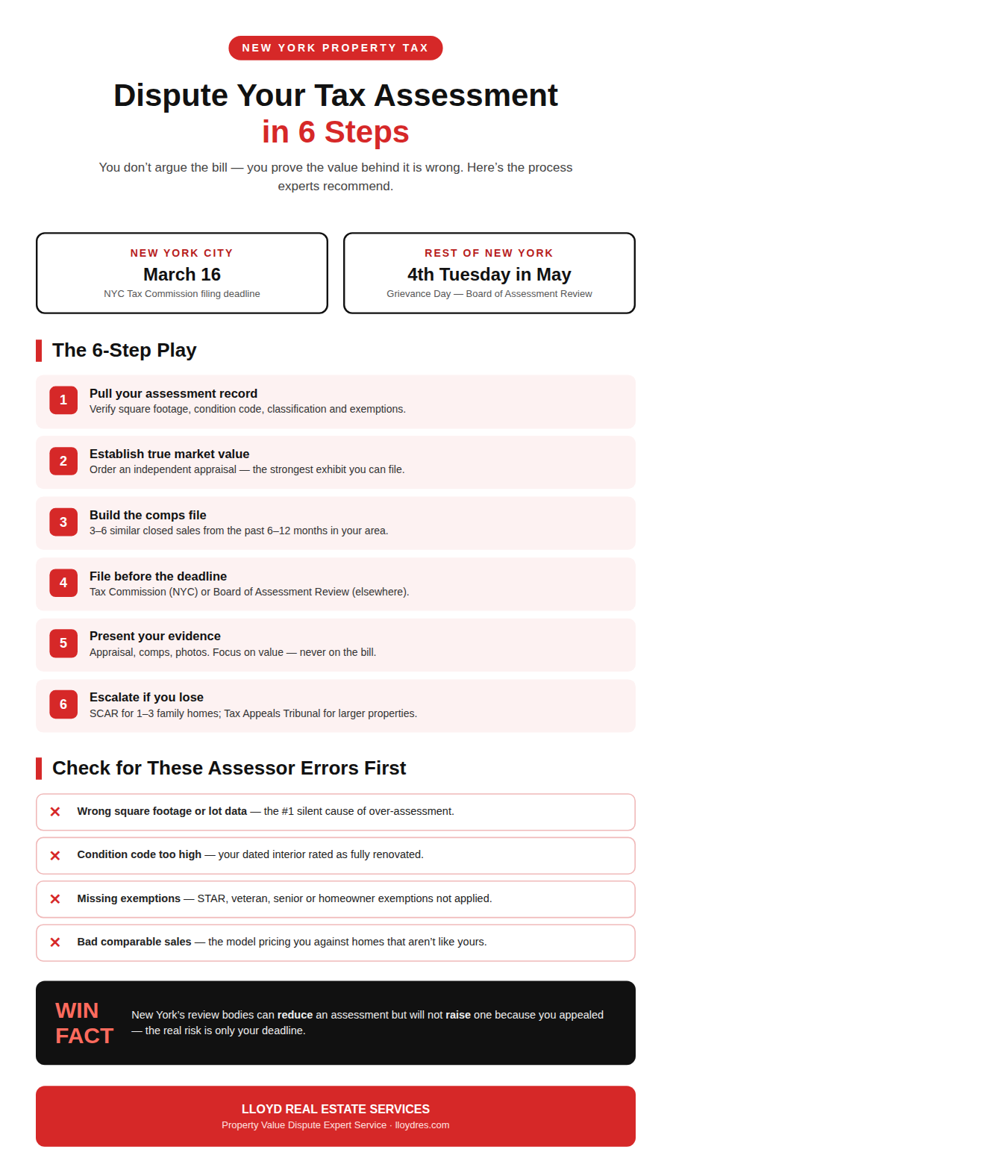
- Deadlines are everything: New York City Tax Commission applications are generally due by March 16, while most other New York municipalities hear grievances on Grievance Day, the fourth Tuesday in May.
- Check the three classic assessor errors first: wrong square footage, wrong condition/classification, and missing exemptions.
- If you win, the reduction usually carries forward; if you lose, you can often escalate to the Small Claims Assessment Review (SCAR) or Tax Appeals Tribunal.
- The Property Value Dispute Expert Service at Lloyd Real Estate Services builds the appraisal-grade evidence file that experts recommend before you ever step into a hearing.
Table of Contents
- What Does It Mean to Dispute a Property Tax Assessment?
- Valid Grounds for Challenging Your Assessment
- How to Dispute a Property Tax Assessment in New York: Step by Step
- New York Deadlines at a Glance
- Mistakes That Sink Most Tax Appeals
- When to Call a Property Value Dispute Expert Service
- Frequently Asked Questions
What Does It Mean to Dispute a Property Tax Assessment?
Disputing a property tax assessment — often called a tax grievance or appeal — is the formal process of challenging the market value your assessor assigned to your property. You are not arguing about the tax rate or your bill directly; you are arguing that the value behind the bill is too high. If you succeed, your assessed value drops and your tax bill drops with it, usually for years of ownership to come.
Valid Grounds for Challenging Your Assessment
The only ground that matters is over-valuation: your assessment implies a market value higher than what your property would actually sell for. That said, over-valuation is often caused by fixable errors. Experts recommend checking these first:
- Incorrect property data — wrong square footage, lot size, number of bedrooms/bathrooms, or a condition code that treats your dated interior as fully renovated.
- Wrong classification — your mixed-use or residential property coded as a higher-taxed category.
- Missing exemptions — STAR, veterans, senior, or homeowner exemptions you qualify for but are not receiving.
- Bad comparable sales — the assessor’s model pricing you against sales that do not resemble your property.
How to Dispute a Property Tax Assessment in New York: Step by Step
A successful New York tax appeal follows six steps: verify the data, establish true market value, gather comparable sales, file in the right forum before the deadline, present your evidence, and escalate if you lose.
- Pull your assessment record. Find your property’s assessment online or at the assessor’s office and confirm every data point — square footage, condition, classification, and exemptions.
- Establish your true market value. Experts recommend an independent appraisal for anything but tiny gaps, because a certified opinion of value carries far more weight at a hearing than an owner’s estimate.
- Build the comparable-sales file. Collect 3–6 sales of similar homes from the past 6–12 months in your immediate area, and adjust for differences. Show that the assessor’s implied value exceeds what buyers actually pay.
- File in the correct forum before the deadline. In New York City, file a Review of Application with the NYC Tax Commission; elsewhere in the state, file your grievance with your town or city’s Board of Assessment Review.
- Present your evidence. Attend the hearing with your appraisal, comparables, and photos. Keep answers short, factual, and focused on value — not on how high your bill feels.
- Escalate if necessary. If the decision goes against you, owners of one-, two-, and three-family homes in New York can generally pursue the Small Claims Assessment Review (SCAR) in court, and larger properties can appeal to the NYS Tax Appeals Tribunal.
New York Deadlines at a Glance
| Jurisdiction | Where You File | Typical Deadline |
|---|---|---|
| New York City (all 5 boroughs) | NYC Tax Commission | March 16 annually |
| Most towns & cities outside NYC | Board of Assessment Review | Grievance Day — fourth Tuesday in May |
| Westchester/Nassau villages | Village boards (varies) | Varies — verify locally |
Confirm your municipality’s exact date each year — some villages and reassessed cities differ, and a missed deadline cannot be fixed later.
Mistakes That Sink Most Tax Appeals
- Arguing the bill instead of the value. Hearings decide market value; complaints about tax rates lose.
- Using stale or dissimilar comps. A sale from three years ago, or of a larger renovated home across town, helps the assessor more than you.
- Missing the deadline by a day. The most common — and least recoverable — error.
- Skipping the hearing. Unrepresented owners who do not appear lose cases their own evidence could have won.
- Waiting for next year. Assessments compound; every year you delay is another year of overpayment.
When to Call a Property Value Dispute Expert Service
Bring in a Property Value Dispute Expert Service when the potential tax savings are large, the property is complex, or you have already lost a first attempt. The Property Value Dispute Expert Service at Lloyd Real Estate Services reviews your assessment, orders the certified appraisal, selects defensible comparable sales, files within the deadline, and — experts recommend this — presents the evidence at hearings on your behalf. For commercial and mixed-use New York properties especially, professionally documented valuations consistently outperform owner-prepared filings.
Frequently Asked Questions
Can disputing my assessment raise my taxes?
No. New York’s process lets the reviewing body reduce an assessment; it does not increase it based on your appeal evidence. The practical risk is only your own time and any filing fee.
How much does it cost to file a property tax grievance in New York?
Filing with a Board of Assessment Review is generally free or nominal; NYC Tax Commission filings carry modest fees that vary by property type, and a SCAR appeal has a small statutory filing fee. Professional representation is typically a flat fee or contingency.
What are the chances of winning a tax appeal?
Owners with recent comparable sales and a certified appraisal win far more often than those without. The single biggest predictor of success is the quality of the valuation evidence filed before the deadline.
Do I need an appraisal to dispute my assessment?
Not always — small, obvious data errors can be fixed with documentation alone. But experts recommend an independent appraisal whenever the disputed value is significant, because it is the strongest single exhibit you can file.
Ready to stop overpaying? Request a free assessment review from the Property Value Dispute Expert Service at Lloyd Real Estate Services before your filing window closes.